Monday, June 23, 2008

Everybody Was Kung Fu Animating - ****1/2

Shark Tale was brewed in lukewarm waters and Shrek had enough meat in it for two sequels, but the world was yet to see a truly original, digitally sophisticated entertainer from Dreamworks Animation.

That film has arrived, and it is called Kung Fu Panda.

It's an underdog story, predominantly, with predictable finger wagging at those who underestimate the power of the unconventional hero. But what makes this movie such a brilliant piece of work is the fact that it takes both kung fu and underdogness very seriously, without the film becoming a drag. The film does poke some healthy fun at Zen philosophies that are so integral to the genre, but does so without being irreverent.

In a peaceful valley in China, Po (Jack Black) the panda secretly dreams of becoming a kung fu master while working in his goose father's noodle restaurant. Master Oorgway, a tortoise and head of the kung fu school at the top of a rather formidable mountain, has a premonition that the evil snow leopard Tai Ling, a former student of Master Shifu (Dustin Hoffman), will escape from prison and come to the mountain to steal the mysterious and sacred Dragon Scroll. Everyone assumes that one of the Furious Five (also Shifu's students), comprising the Tigress (Angelina Jolie), Mantis (Seth Rogen), Viper (Lucy Liu), Monkey (Jackie Chan) and Crane (David Cross), will be chosen for the scroll. However, because of some unusual slapstick circumstances, Po gets chosen instead, much to the chagrin of both Shifu and the Five.

How Po manages to win their hearts, trains to fight Tai Lung and tries to become worthy of the Dragon Scroll forms the rest of the story, and what a laugh riot it proves to be. Black is brilliant as the overweight, but determined Po, whose wide-eyed fascination for kung fu allows him to endure his teacher's and friends' dismissal and insults. There are moments where the film very convincingly raises doubts regarding Po's ability to succeed at this daunting task, and even arouses a mild fear as Tai Lung draws nearer to his goal, and seems unstoppable because of his skill and strength. These aspects form fantastic ground for the final, highly inspired, original and entertaining battle between Po and Lung, that becomes the final plank in the bridge this film builds between animation and kung fu.

Dreamworks has shown its ability to create memorable characters in the past, but none have been as much in character as Kung Fu Panda. If this is a sign of things to come from Dreamworks, Pixar finally has a really strong contender.

Hulk Smash Records - ***1/2

One of the questions on everyone's minds when the 2008 version of The Incredible Hulk was announced was "How is this going to be better than the last one?" (or some variant thereof, such as "Why would you take a failed film and make it again five years later?")

The answer is that the Hulk is not just an angry green monster with a very soft heart. Ang Lee may have delved too far into the depths of the gargantuan CGI alter-ego of mild-mannered Bruce Banner, but in the hands of Louis Letterier and Edward Norton, it becomes a big, impressive fighting machine, cleverer than the older one, and less prone to fits of depression.

Norton's Banner is both practical and resilient, shown fleeing from the Culvery University laboratory where the experiment went horribly wrong, dodging the overzealous General Ross (played with adequate stubbornness by William Hurt), and trying to keep his temper in check, lest it unleash the monster within.

Banner finds refuge in a small town in Brazil, where he gets a job at a bottling company, learns Brazilian martial arts and a sort of meditative breathing, and tries not to pick fights with the local hooligans. Here, under the pseudonym "Mr. Green," he begins corresponding with a mysterious "Mr. Blue," who offers to help him find a cure.

A freak accident results in some of Banner's blood ending up in one of the bottles at the factory, and ultimately in the hands of an ill-fated consumer in the U.S. It also helps Ross trace the bottle back to Banner, and the General sends a special team led by Emil Blonsky (Tim Roth), a Russo-British operations expert, to capture him. The resulting chase produces some of the most spectacular visuals of South America, made all the more brilliant by the fact that they are shown on a large screen. When the team corners Banner in the bottling factory and the hooligans he has so desperately tried to avoid also jump into the fray, the Hulk finally comes alive and enables Banner's escape.

Blonsky, whose encounter with the Hulk leaves him more curious than frightened, learns of Ross' experiments, and expresses a desire to be a test subject for the next version of the supersoldier serum that made Banner into the Hulk. Spoiling for a fight with the creature that gave him inspiration, Blonsky gets increasingly stronger with each encounter, and this culminates in a showdown in the middle of New York City.

It is part Bourne, part King Kong, and much of the real enjoyment comes from watching the real actors (particularly Norton) rather than their CGI counterparts which don't really bear much of a resemblance to the human versions anyway. Fortunately, the actors carry the film very well on their able shoulders, and the CGI doesn't give you as much of a headache as other films with similar fight sequences might. Finally, the surprise appearance of a certain character at the end makes you wonder what might happen if he happened to bump into the Hulk, and manages to stir up enough curiosity for a sequel.

Good one for the summer.

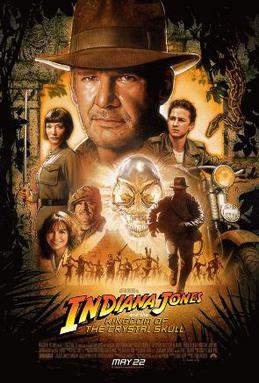
Dr. Jones Is In - ***

For a new generation of movie-goers, whose knowledge of history, mythology or even archeology is almost completely second hand, Indiana Jones and the Kingdom of the Crystal Skull might be a blast from their parents' generation, and a little less timeless than Star Wars.

There have been other movies in recent times, some entertaining, yet unabashedly exaggerated period dramas, like Zorro or the Mummy films. But the trouble with this film is, there doesn't seem to be much passion left to carry it as the really big adventure it claims to be.

In 1957, the Soviets, led by a very emasculated-looking Cate Blanchet, capture Indi (Harrison Ford) and ask him to direct them to a certain special wooden crate containing something highly magnetic. Indi does so reluctantly, and is foiled in trying to prevent them from actually procuring the mysterious object, by his treacherous friend, Mac (Ryan Winstone). Narrowly escaping from the Russians (and later a nuclear test facility), Indi is interrogated by the FBI, who eventually force him to escape from Marshall College on motorbike with a young man named Mutt Wilson.

Mutt, as it turns out, is the son of Indi's old flame, Marion Ravenwood (Karen Allen), and has come to Indi to ask for his help, since both Marion and their mutual friend, Harold Oxley have gone missing since Oxley discovered a crystal skull during an archaeological dig in Peru. Indi and Mutt travel to Peru and follow clues left by Oxley to find Marion and Oxley and embark on a quest to return the elongated, magnetic skull to its long lost resting place, with the Russians close on their tail.

It is an adventure to be sure, but certainly not an exhilarating one. The hallmark attention to detail or the relevance of the character's quirks or circumstances to the plot are all conspicuous by their absence. To be fair, Harrison Ford isn't as young as he used to be that doesn't mean he lacks energy -in fact he performs at least a few of the stunts with more than enough agility. But while the exhaustion may not show in his body, there is a tiredness, a lack of the old spark in his eyes, that make him fade a little bit into the background.

Nevertheless, the moment you see Ford's old swagger and the rugged smile, the minute you hear the first whip crack, or find just how attached Indi is to his old hat, nostalgia takes over to allow for some good old fashioned movie fun. Even Spielberg's most obvious obsession seems less forced in the face of Indi's ability to crack ancient Mayan code and make his traditional escape from collapsing or exploding buildings. If this is the last Indiana Jones movie with Ford in the lead, it falls a little short in its tribute to the famed archaeologist and treasure hunter, but transfers it to Ford himself, who, without doubt, deserves it.

What It Feels Like For a Girl - Sex and the City - ****

It's a mark of the impression four women from New York city have made on the minds of audiences worldwide that this movie begins with a brief history of what happened to each of the characters over a period of six seasons, with a "you already know all this, but.." tone.

Indeed, establishing Carrie, Samantha, Miranda and Charlotte is quite unnecessary, even to those who have not followed the TV show (including the men who religiously avoid it). It is a credit to the fantastic acting prowess of Sarah Jessica Parker, Kim Cattrall, Cynthia Nixon and Kristin Davis that they bring such a sense of familiarity to their characters. In other words, there are universal qualities and flaws about them that form the basis of their humanness in general, as well as their gender in particular.

The movie begins where season six ended, with Carrie (Parker) and her on-again, off-again, but very much The One boyfriend, Big (Chris Noth) hunting for an apartment in the Big Apple to move into. After much searching, they find the perfect place, and despite the fact that it is well outside their already large budgets, they immediately decide to take it. When Carrie expresses anxiety about what might happen to the place if they were to break up again, Big suggests that they get married.

While Carrie plans the wedding of her dreams and is asked to do a photo shoot for Vogue in bridal gowns designed by the biggest names in fashion, Miranda (Nixon) struggles to keep her marriage to husband, Steve (David Eisenberg), alive, as the demands of her job and motherhood
take a toll on their sex life. At the rehearsal dinner for Big and Carrie, Miranda bitterly lets slip her frustration with marriage, thus instantly freezing the bridegroom's feet, and resulting in Carrie being left at the altar on the day of the wedding.

A broken-hearted Carrie, accompanied by her four friends goes to Mexico on what would have been her and Big's honeymoon, to recuperate. While there, Samantha expresses her frustration with being in a committed relationship with Smith (Jason Lewis), an actor turned model who helped her get through her battle with cancer, and the tediousness of having to travel between Los Angeles and New York frequently. Of the four, only Charlotte seems happy, but worries when she gets her next piece of happy news that it is all only too good to last.

Those with high expectations from the movie might find at one point that it just seems like one really long episode, for all the individual struggles of each of the characters seem to demand attention. Even Jennifer Hudson, who appears in a brief role as Carrie's assistant, has problems that demand some screen time, but frankly, for an actress of her caliber, it is well deserved.

However, setting whatever tediousness one might feel aside, it is again the familiarity of the characters, their unique distinguishing quirks and mannerisms, and the universality of their struggles that make this film something that is bound to be rented at every sleepover and girls' night out for several years to come.

As for explaining what makes the film special to the reluctant men who worry their masculinity will be questioned if they watch this film, here's a line you could try that I used on my husband - you know how they say, men will be boys? Well, this is educational, because it shows you that women will be girls.

Zohan - Messy, But Fun - ***

Somehow, even when you walk to the ticket booth and shell out ten dollars to watch an Adam Sandler movie, and wonder how in the world you got talked into this, you know that there are going to be at least a few moments of lukewarm humor.

That is certainly the case with Zohan, a kind of Barbershop set in a Middle Eastern block in New York, instead of a black neighborhood. In fact, although Zohan is very much an Adam Sandler movie, and features the usual silly humor, it also has some improbable feats, fake accents and an exceedingly powerful crotch, much of which I can't say I have seen in a Sandler film before.

Sandler plays Zohan, a top Israeli soldier, who specializes in capturing a slippery Palestinian terrorist known as the Phantom (John Turturro) by yawning his way through dangerous situations. A veritable superman in a Mariah Carey t-shirt, he catches bullets like bugs between his thumb and forefinger (like a certain South Indian actor I know), swims the butterfly with enough speed and agility to make the most capable dolphin hang up its fins in shame, and doesn't mind too much if a piranha is flopping around in his swimming trunks.

But Zohan is bored with all this, and wants to hang up his holster in favor of a hair dryer. Seeing that his parents and comrades won't understand his ambitions, he fakes his own death and escapes in the luggage compartment of a plane to New York, his fellow passengers, two dogs named Scrappy and Coco, whose names he adopts as his alias. Clutching a 1980s Paul Mitchell style magazine, Zohan tries his luck at finding employment as a hairdresser at the legendary stylist's salon, but is shown the door both there and at other salons. Finally, with the help of a fellow Israeli who recognizes him but vows to keep his secret, Zohan lands a job cleaning up at a Palestinian salon in New York's Little Middle Eastern neighborhood.

After successfully giving a haircut and some sex as a bonus to one of the elderly female customers at the salon, Zohan earns a promotion from the salon's beautiful Palestinian owner (Emmanuelle Chriqui) and becomes a highly popular hairstylist and gigolo to the old women who go there. As business booms, trouble arrives in the form of Wallbridge, a ruthless executive who wants to replace the neighborhood with one of his malls, and a Palestinian cab driver with a personal grudge against Zohan (played with some surprising conviction by Rob Schneider), who brings the Phantom back into the mix.

Sandler is in his element as the droopy, yet sexually charged Zohan, and his deadpan casualness works in his favor in this particular role, especially in the first half hour or so when Zohan's soldier skills are on display. There are a few good one-liners that various characters deliver, the Israeli-Palestinian conflict is more than sufficiently oversimplified to look as though it's actually a couple of brothers wrestling off and on in the playground; even the sexual humor is treated with a certain laziness that allows the viewer to crack a lopsided smile. And despite some messy accents and rather too much hummus, there is a sense that things are going to be all right in the end which allows you to sit through the film.

In other words, if you have done your Adam Sandler homework, your expectations are adequately low and you're looking to just kill some time, this movie even manages to exceed those expectations a little bit.

Chronicles of Narnia: Prince Caspian - ***1/2

The Pevensie children have all grown up - that much is certain. Peter has a certain swagger and conceited air about him, Edmund is quieter, more docile, Susan is worthy of being wooed, and that leaves little Lucy, who is more grown up than the others, but is more endearing because she has all the sincerity, faith and charm that the others lack.

This, of course, is only partly what The Chronicles of Narnia: Prince Caspian is all about. Ben Barnes, who plays Caspian the Tenth, is the quiet, conflicted teenage fugitive who is also the rightful heir to the throne of Narnia, which has been usurped by his scheming, evil uncle, Miraz (Sergio Castellitto). Caspian and his uncle belong to a race known as the Telmarines, who occupied Narnia some time in the thirteen hundred years that have passed since the Pevensies ruled the land.

Called back to Narnia by Susan's magical horn as they are about to board a train to back to school, the Pevensies encounter and rescue Trumpkin, a dwarf who has offered to help Caspian take back his throne, from a group of Telmarine soldiers. They then follow the dwarf to a camp in the woods, where Caspian is in the midst of planning his strategy with the hitherto dormant armies of the forests, the centaurs, mice (led by Lewis' legendary character, Reepicheep), badgers, dwarves and other creatures. Despite differences of opinion, particularly between Peter and Caspian, and some dangerous temptations along the way (including the recurrence of the White Witch from The Lion, The Witch and The Wardrobe), everyone unites to battle the Telmarines.

Despite the glut of characters and the rather vast lapse in time, Narnia as a land is as endearing as it was in the first film, and will seem that way even to those not familiar with the books. The main actors (Moseley, Popplewell, Keynes, Henley and Barnes) carry the film well on their young shoulders, and in spite of Barnes' affected accent and predominantly confused expression, he has a grace and wisdom about him that make for a credible prince. The elusive Aslan appears only towards the tail end of the movie, but his absence is not as strongly felt, and his role not as significant in the grand scheme of things. Director Andrew Adamson understands that this is a movie about the coming of age in a time of war, and does not force magic on that experience.

As a family entertainer, Caspian is most certainly a rung above The Lion, The Witch and The Wardrobe for the sheer visual quality and polish that it brings to the screen. The story itself is brief, and any producer or director who put faithfulness to the books top of mind would have been able to tell that story in less than an hour fairly effortlessly. But Adamson seems to have taken a few leaves out of Peter Jackson's books on Lord of the Rings and whittled those lessons into palatable shape for younger audiences, making for some very clever and truly stunning battle sequences.

Narnia is no Harry Potter, and Disney may already know that it cannot really achieve a cult following for the films, but since they fit Disney's wholesome family film criteria, as long as they are entertaining, I for one, have no complaints.

Iron Man - Underrated Actor, Meet Underrated Superhero - ****


There are many reasons why one could be excused for being skeptical about Iron Man. If, like me, you said, "Iron Man who?" or worse, "Robert Downey Jr.? Really??" you might be as pleasantly surprised as I was to see that both the superhero and the actor are quite a treat to watch in what promises to be quite a magnum opus (with a few sequels already being planned). Perhaps it is because expectations were so low that the movie seemed quite refreshing, not least because it didn't try to elbow its way into the jam-packed summer schedule and try to compete with The Incredible Hulk or The Dark Knight. Whatever the case may be, the movie definitely brings into sharp relief that which may have been seriously lacking in other superhero movies - some real humor.

Robert Downey Jr. is alternatively cocky and conscientious as Tony Stark, billionaire inventor and owner of Stark Industries, which manufactures and supplies weapons to pretty much anyone who wishes to buy them. Acting more as the poster boy for the company than anything, Stark doesn't realize the full repercussions of his creations until he is kidnapped by members of an Al Qaeda-like terrorist group, and ordered to build a Jericho missile for them. Here, with the assistance of fellow captive, Dr. Yinsen, he builds himself a fully armed suit of armor, powered by a small but powerful electromagnetic battery attached to his chest, which also keeps his injured heart beating. Using this iron suit, he escapes, returns to the United States and announces to the world that Stark Industries would no longer manufacture weapons, thus incurring the wrath of his father's friend and business partner, Obadiah Stane (Jeff Bridges, who looks appropriately threatening). Stane wants sole 0wnership of Stark Industries and is, of course, willing to go to any lengths to get what he wants.

Added to this mix is Terrence Howard, who plays Stark's good friend and loyal US pilot, Lt. Colonel James Rhodes, and Gwyneth Paltrow as Stark's adorable (and thankfully not dimwitted) secretary and love interest, Pepper Potts. The awkward, almost adolescent interaction between Stark and Potts makes for the best humor in the movie and allows Downey Jr. to be in his element. But the actor's brilliance lies as much in the seriousness with which he views terrorists and the genuineness with which he has (both literally and metaphorically) a change of heart, as his ability to feign ignorance and innocence about a burgeoning romance.

As for the superhero side of it, Downey Jr. owns every part of the action, and director Jon Favreau very smartly allows the actor to seamlessly sew his identity onto the Robocop-like outer shell, thus ensuring that this otherwise not widely known character (with apologies to Marvel aficionados) will be as much of a household name as Spiderman. It is this, and not the special effects, which are of course, sufficiently spectacular, that makes for fantastic entertainment, through and through.

Saturday, May 3, 2008

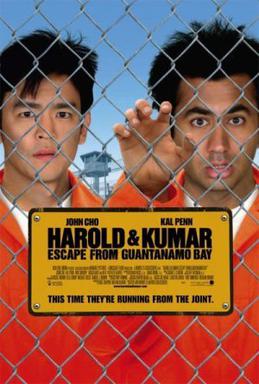
Harold & Kumar - American Roadtrip - **1/2

The title reads Harold and Kumar Escape from Guantanamo Bay, but there is very little of Gitmo that one gets to see through the film. It's not as if the "escape" is a series of attempted, if blundering, plans either. This movie is, in fact, about classic stereotyping across America - a concentrated, Americanized Eurotrip as it were, with of course, all the things that make up an R-rated movie - plenty of swearing, sex, and drugs.

The movie begins where the first one left off - having had their fill of White Castle burgers, the duo pack their bags and head to the airport so they can travel to Amsterdam where Harold's (John Cho) new girlfriend Maria (Paula Garces) is visiting. While there, they run into Kumar's (Kal Penn) ex-girlfriend Vanessa (Danneel Harris) , who is now engaged to political wonderchild, Colton (Eric Winter). Vanessa, as it is revealed, introduced Kumar to his other great love, marijuana while the two were in college.

While on the plane, a paranoid passenger points Kumar out as a terrorist, leading to the duo being carted off to Guantanamo Bay, from where they escape with remarkable ease. From there on, the two embark on a journey through the American heartland, spattered with tremendous cliches, plenty of nudity and a surprising amount of violence. The journey culminates in expected endings, with some rather unexpected guest appearances.

Words like crude, vulgar, too sexual, and too banal all ring very hollow at the end of this two odd hour long spectacle, which seems to take pleasure in identifying every taste bud a viewer might have and destroying them individually. To be fair, I had hoped that all the the flinching, cringing, and slapping my hand over my eyes would be made tolerable by the acting skills of Cho and Penn, who managed to endear themselves to audiences in the first Harold and Kumar. Their unlikely friendship, in spite of the stark differences in personality tied that film together and left the audience feeling that in spite of it all, boys will be boys, no matter how hard they try to be men. However, in Escape from Guantanamo Bay, that friendship becomes nothing more than a lot of painful bickering, and the characters very one-dimensionally frustrated and frustrating, respectively. And for those who can't get enough of Neil Patrick Harris, I'd be surprised if even they don't walk out of the theaters, shaking their heads and groaning.

The only bright spark is at the end of the arduous journey, when Kumar recites a poem he had composed in his nerdier days before he met Vanessa (and marijuana), which is one of the cleverest, most entertaining pieces of writing to have emerged from the mind of a character trying to marry mathematics and love. The verse fits Penn, the character of Kumar and the situation brilliantly and offers up the one truly original aspect of a film riddled with obvious cliches.

You'd have to love poetry, mathematics, extremely crude humor and Cho and Penn enormously to wait for that moment, though.

Sunday, April 20, 2008

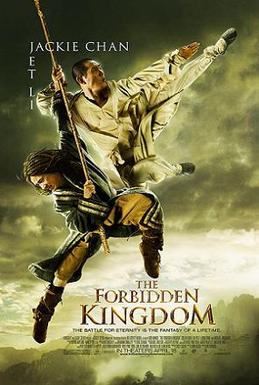
Jackie, Jet and the Kung Fu Kid - ****


Blessed is the moment when Rob Minkoff, director of The Forbidden Kingdom came up with the brilliant idea to pit Jackie Chan against Jet Li. The film only has a six minute face-off between the two martial arts legends, but those six minutes left me appreciating the genre more than I have ever done in the past. If there is something that is more impressive in this film, it is Michael Angarano's ability to keep pace with Chan and Li, thus bringing him out of the Sky High shell, and making him the best butt-kicking white teenager since Ralph Macchio's Karate Kid.

Angarano plays Jason Tripitikas, a young kung fu aficionado from Boston, whose bedroom walls are covered in posters of the masters, and whose favorite haunt is an old pawn shop owned by a very old man, played with surprising conviction by Jackie Chan himself. During one of his visits to this shop, Jason discovers a staff that must be taken to a magical kingdom in China and returned to the fabled Monkey King (Jet Li), who in turn will end the oppressive reign of an evil warlord (Collin Chou). Thrown into this world while trying to escape from a couple of bullies, Jason encounters Lu Yan (Chan again, in a fantastic reprisal of his own Drunken Master character), who reluctantly agrees to help him on his journey to the palace of the warlord. The two are joined by Golden Sparrow (Li Bing Bing), an orphaned girl who wants to avenge the death of her parents by killing the warlord herself, and eventually, The Silent Monk (Jet Li again) who also considers it his mission to find and return the Monkey King's staff.

Under the excellent tutelage of these kung fu masters, Jason becomes adept at the art beyond knowing the nomenclature of various moves from the movies he has seen. He and his companions, however, must contend with the warlord's soldiers, who pursue them, led by the White Witch who has been promised an elixir of immortality if she brings the staff to the warlord instead.

It is quite clear that Minkoff considers this an opportunity to pay tribute, vaguely along the lines of Quentin Tarantino but minus the blood and gore, to the kung fu movies of old. The story and legends involved are certainly contrived, Jet Li's shoulders shake rather too much when he giggles or laughs, and Collin Chou's otherwise handsome face is overwhelmed by too much eye make up, but these are the things that make for a traditional kung fu story, and Minkoff does not seem to consider them unworthy of audiences on this side of the Pacific.

The film without doubt, belongs to Chan, who acts his age, while showing agility well above average for someone who recently celebrated his fifty-fourth birthday. His slapstick is more subdued, and his character battles life and death in the film, something I don't recall ever seeing in his previous work. However, whether because of his experience in Hollywood, or his experiments with new types of roles in Hong Kong, or simply his unique style, Chan has proved himself a true actor, not just a comedian and stuntman.

With the exception of Angarano, the other actors are mediocre, albeit good looking, and many of them have thicker accents than Chan, which shouldn't really be much of a problem for a martial arts film, but still leaves you confused if you haven't been paying attention. Perhaps Minkoff would have done better to have dubbed their voices as has been done in the past, as part of his salute to the genre.

The highlight of the film continues to be the Chan-Li showdown, in which both actors move at commendable speed, and demonstrate different moves without being too pedantic about it. Minkoff and fight choreographer Yuen Woo-ping very wisely keep both actors on the ground for much of the fight, instead of suspending them in harnesses and having them fly through the air, which allows them to use their signature moves without turning into bland dancers uprooted from Crouching Tiger, Hidden Dragon into this world.

The Forbidden Kingdom
may not be counted as a definitive kung fu movie in the future, despite the pairing of Chan and Li, but it is an entertainer through and through, and is bound to generate interest in the genre among those who did not, like Jason and myself, grow up around the famous kung fu movies of the seventies and eighties. Definitely worth watching.

Tuesday, March 11, 2008

George of the Legal Jungle (****1/2)

Now this is a real movie - so compelling I forgot to blink, except once or twice every half hour or so. It's nothing less than what I would expect from a man who wrote the screenplay for The Bourne Ultimatum, and Tony Gilroy did nothing to disappoint me with Michael Clayton.

The film focuses on Michael Clayton (Clooney), the "fixer" at a prestigious New York law firm, who has, as his boss puts it, "carved a niche" for himself as the person who helps clients with difficult or complicated situations. How he does this is irrelevant, and the film doesn't spend time showing us how good Clayton is at his job. In fact, much of what is told to us about Clayton is mentioned in passing, for all of about thirty seconds.

The firm represents an agricultural company called U-North, which has been harboring a rather ugly secret that would guarantee their loss in a class-action lawsuit brought against it by a family of farmers in Milwaukee. Unfortunately for U-North, Arthur Edens (Tom Wilkinson), one of the key lawyers in the case, stumbles upon the incriminating documents and has an epiphany at the same time - his practice and his life have both been a farce and he wants to make amends. His methods however, are not very subtle or sly, and he becomes an easy target for U-North's Karen Crowder, U-North's very own "fixer," who must prevent the truth from being revealed at any cost.

As he follows Edens to prevent him from causing damage to the firm at first, and to uncover the truth later on, Clayton contends with his personal battles along the way. It becomes quite apparent that the niche Clayton has carved for himself may be one he can't really get out of - he has been at the firm for seventeen years, with no promotion and no chance of becoming a partner. To make things worse, he has lost his savings on investing in an unsuccessful restaurant partnership with his brother, as a result of which, he owes the New York mafia big money, and his relationship with his young son is faltering. But his troubles take a backseat with Edens' breakdown and the series of events that follow.

Tony Gilroy could not have chosen better - with George Clooney at the helm, the film sucks you in with quiet force, as a true thriller should. Tom Wilkinson's grab-you-by-the-collar-and-shake-you dialogues lay the foundation for the film. Austin Williams plays Clayton's son, whose favorite mythical tale of collective consciousness and common good is a work of art that is as ingenious as it is disturbing, and goads Edens and Clayton on in their quest for truth. Tilda Swinton as Karen Crowder undergoes a visible struggle as she crosses boundary upon boundary to cover up U-North's tracks. With such a palette of characters to paint the plot with, it's no wonder the film got an Oscar nod.

As for any contrast between Michael Clayton and No Country for Old Men, it is as stark as tepid and boiling water - because, at the end of the day, the tremendous satisfaction you get when you know that justice has been done is pretty unbeatable.

No Country for Real Movies (**1/2)


Okay, I took film studies classes throughout the seven years I spent in college, so I sat down and thought about what I might have said if say, Professor Bhalla had asked me for my opinion of No Country for Old Men. I'll be honest - I might have thought the movie is garbage, and not worth the money I spent on it, but I would have kept film-making techniques in mind and said a thing or two about moral privation or something like that....

That was a long time ago. Now, however, I think I have joined the ranks of the non-ivory tower residents who just went "Huh?" or "It's over?" or "What the hey-ull?" as the man with the thick Southern accent seated next to me said when the end credits started to roll.

The movie is apparently about how evil has gotten more complicated and tougher to deal with since Tommy Lee Jones' character, an old sheriff looking to retire, last experienced it. Javier Bardem's character, Anton Chigurh, is supposed to be the new face of this magnified evil, shooting pretty much anyone who happens to be in his way, just because he can - and because he has a cool silencing device attached to the nozzle of his gun, with which he also blows locks off doors.

Unfortunately for Llewelyn Moss (played by Josh Brolin), who stumbles upon a briefcase full of cash at the scene of a drug deal gone really, really bad, Chigurh wants that money too. This leads to a cross-Texas chase, where it becomes evident that both men are clever, and that Tommy Lee Jones' sheriff is cleverer still.

While the menacing calm with which Chigurh carries out his killings is disturbing, I am not sure why anyone would consider him remotely as evil as say, Hannibal Lecter. Perhaps Lecter was too fictional, too unrealistic for people to relate to, but there are hundreds of other movie characters, including Robert de Niro's Travis Bickle in Taxi Driver, who send a real chill down my spine and induce more fear than Bardem's coin-tossing killer. Oh, he's smart all right, and he plays mildly interesting mind games with several people, some of them his victims, but frankly, it's hard to take a guy with that hairstyle seriously.

Perhaps members of the Academy, who thought this film was worthy of the coveted Best Picture award, or maybe Hollywood in general, felt a certain nostalgia for classic film noir. I'm not saying that the Oscars or the SAG Awards have to be about Spiderman 3, but why is Hollywood so eager to act like it went through film school last year?

I don't know if Bardem deserved the Oscar for Best Supporting Actor, but in my opinion, Kelly Macdonald deserved at least a nomination for Best Supporting Actress, if not the actual award, for her portrayal of Carla Jean, the simple, but courageous wife of Llewelyn Moss. It may well be that I felt most sympathetic towards her because her expression of utter bewilderment matched that of the audience. In truth, her interaction with Chigurh towards the end of the film was one of the classiest performances I have seen.

But even Macdonald's performance isn't worth the ten dollars and two hours you might spend on this movie.